Two Insurance Products That Share a Name and Almost Nothing Else

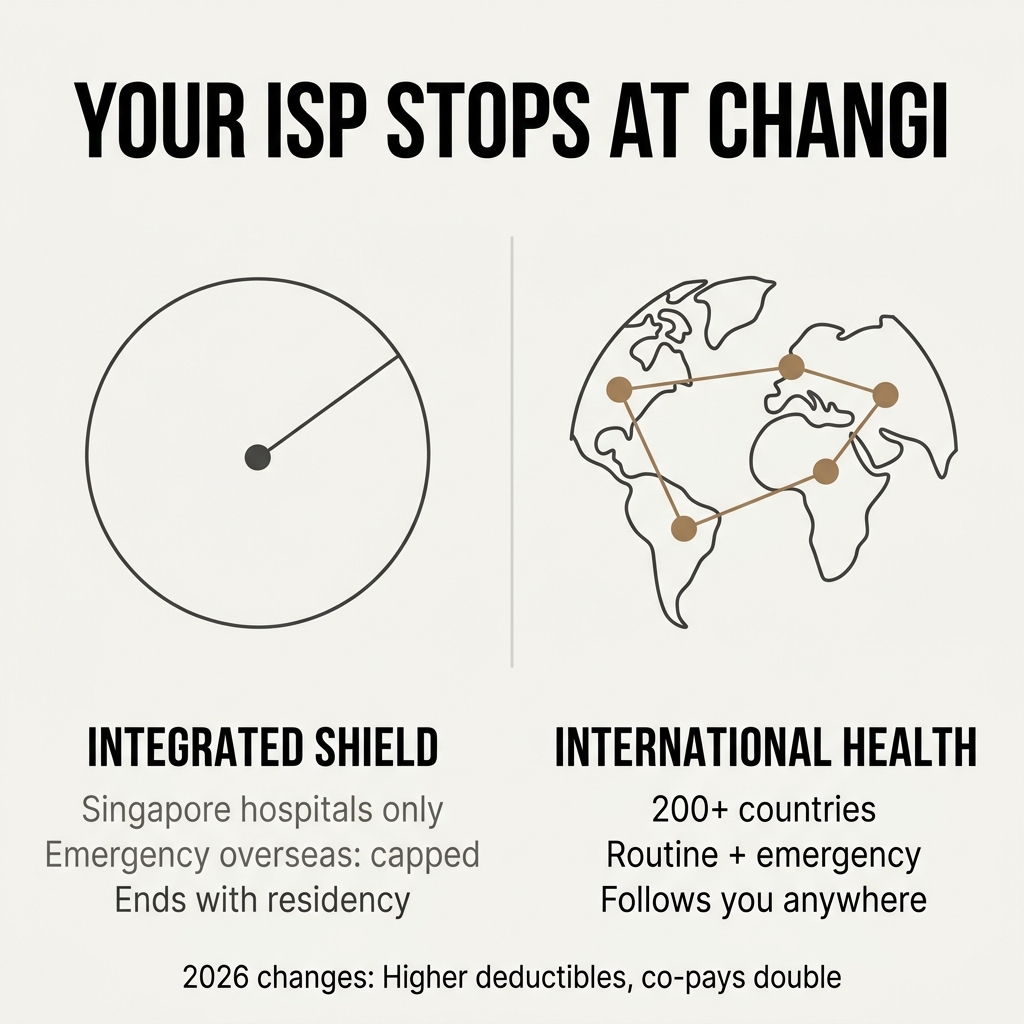
Over the past few years, I've sat across from a growing number of clients who hold both a Singapore Integrated Shield Plan and a passport full of stamps. They travel for work, keep a second home abroad, or have adult children studying overseas. When I ask how their health coverage behaves once they leave Changi Airport, the room usually goes quiet. The assumption is that their shield plan (ISP) is able to take care of their hospital treatments overseas during emergency scenarios. That assumption deserves a closer look, because the two categories of insurance involved were built for entirely different lives.
What an Integrated Shield Plan Actually Is
An Integrated Shield Plan sits on top of MediShield Life, Singapore's compulsory national scheme. Its job is specific and it does that job well within its design. It raises your coverage for hospitalization in private hospitals or higher ward classes in public ones, and it settles those bills through a system built around Singapore's healthcare infrastructure. The plan assumes you live here, get treated here, and recover here.
The boundaries of that design are commonly overlooked. ISPs cover hospitalization bills only, which means outpatient treatment, dental care, eye checkups, and maternity sit outside the structure entirely. You pay for those from your own pocket, regardless of how comprehensive your plan looks on paper. This isn't a flaw in the product. It's the product working exactly as designed, for a scope narrower than many policyholders picture.
Overseas, the boundaries tighten further. Your ISP covers emergency treatment abroad, typically capped at what a similar procedure would cost in a Singapore private hospital. Routine care overseas, planned treatment overseas, and follow-up care overseas all fall outside the plan. If you relocate away from Singapore permanently, the coverage ends with your residency. The plan is rooted in a national framework, and it stays rooted there.
Where Travel Insurance Fits, and Where It Doesn't
Travel insurance is the product most Singaporeans reach for first when they think about overseas health risk, and understandably so. It's familiar, affordable, and easy to buy before a trip. For what it's designed to do, it performs that function well. Emergency evacuation, trip cancellations, lost luggage, and acute medical events that occur suddenly while abroad — these are the scenarios travel insurance was built around. If you break a leg skiing in Japan or need appendix surgery in London, a travel insurance policy will typically respond, subject to its own exclusions and claim conditions.
What it doesn't do is often less visible. Travel insurance is a short-duration product, typically capped at 180 days, and it is structured around the idea that you will return home for any non-emergency follow-up. Pre-existing conditions are almost universally excluded or heavily restricted. Planned treatment overseas, specialist consultations, ongoing chronic disease management, and mental health support fall outside most travel policies altogether. The product was designed to help you get home safely, not to serve as your primary health cover while you're away. Treating it as the latter is where the gap opens.
Within Singapore, this distinction is more relevant than it might appear. A meaningful number of residents travel frequently for work, spend extended periods in a second country, or care for family members abroad. When they purchase an ISP and a travel insurance policy, many assume the combination is complete. The ISP handles Singapore, and travel insurance handles the rest. In practice, travel insurance handles the acute emergencies that fit inside its duration limits and exclusion list. Everything outside that boundary lands in uncovered territory. The assumption of completeness is generous. The contract is precise.
What International Health Insurance Was Built To Do
International health insurance answers a different question. Providers like Cigna Global, Bupa Global, and Allianz Care design their plans for people whose lives cross borders regularly. Cigna Global, for instance, offers coverage across 200 markets with access to 2.4 million health professionals and support in over 50 languages, around the clock. The structural premise is portability. Your coverage follows you, rather than anchoring you to one healthcare system.
The scope differs as well. These plans work as modular structures that can include inpatient and outpatient care, maternity, mental health support, and preventive services. You can shape the plan around how you actually live. Many international plans let you exclude high-cost regions like the USA or Singapore itself to reduce premiums substantially while keeping full protection everywhere else. That kind of geographic flexibility simply doesn't exist inside an ISP, because an ISP was never asked to solve that problem.
The market behind these products reflects a real shift in how people live. The global health insurance market now exceeds $2.32 trillion, and many countries now require health insurance as a condition of visas or residency. Domestic plans, including employer coverage, generally provide zero protection for care abroad. Travel insurance covers short trips and sudden emergencies, and it stops there. International health insurance occupies the space between those two, and that space keeps growing.
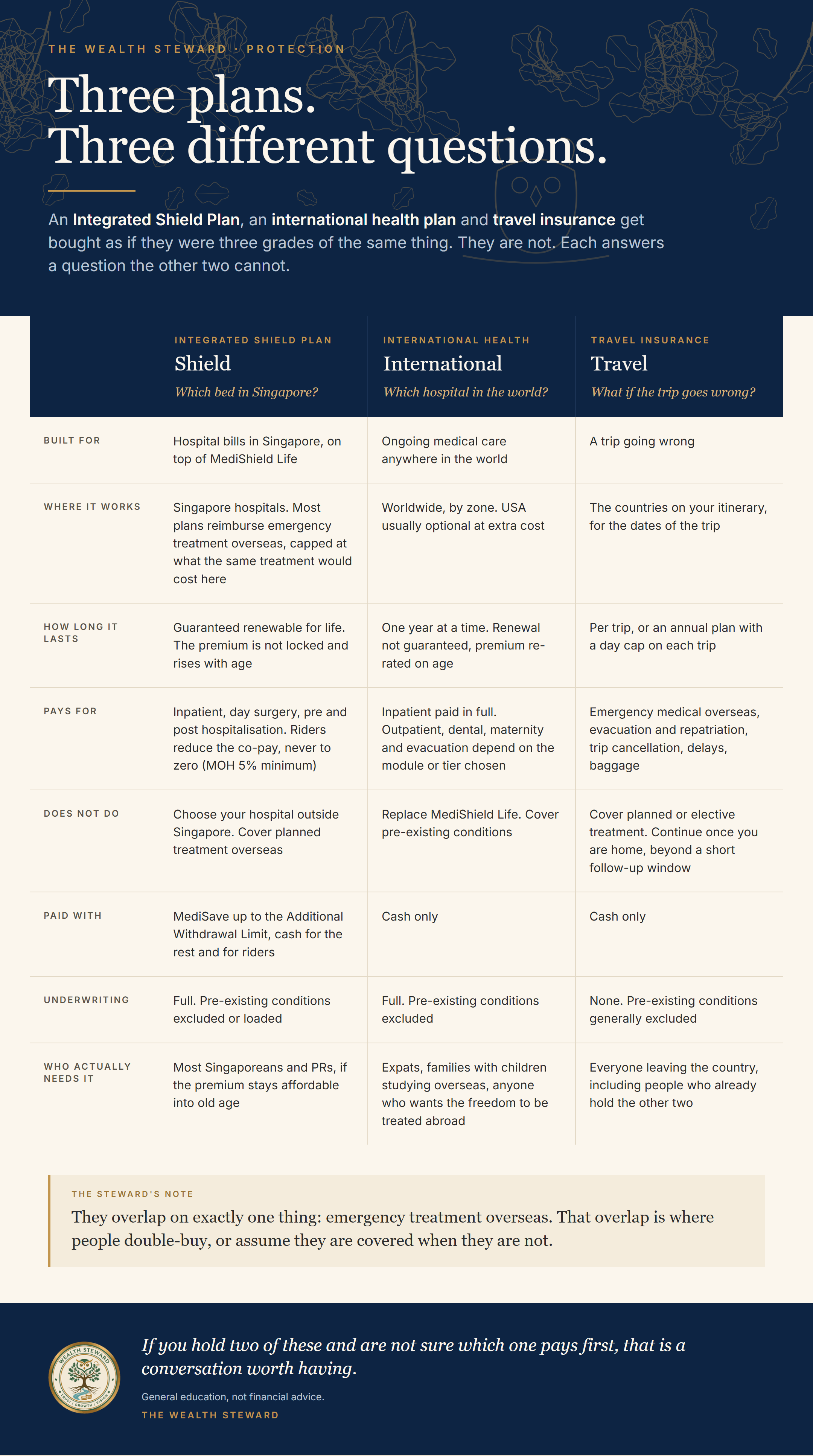
(A comparison summary)
The Trend That Makes This Comparison Urgent
Within Singapore itself, the ground under ISPs is shifting. From April 1, 2026, new ISP riders no longer cover the minimum deductible, and the co-payment cap doubles from $3,000 to $6,000 per policy year. In practical terms, a private hospital stay could mean paying a $3,500 deductible plus a 5 percent co-payment up to $6,000, even with a rider in place. The new riders cost roughly 30 percent less in premiums, and the trade is straightforward. Lower ongoing cost, higher exposure when a medical event actually happens.
I read this regulatory move as part of a broader pattern. Healthcare cost pressure is pushing domestic systems everywhere to shift more risk back onto individuals. The people I advise, mostly professionals in their forties and fifties, are entering the exact decade when hospitalization stops being theoretical. They're also more internationally mobile than any generation before them. Those two trends are converging at the same time, and a plan structure chosen ten years ago rarely accounts for both.
What strikes me most is how the structural changes surface a question that was always there. An ISP holder who spends four months a year abroad has been carrying an untested gap for years. The rider changes simply make the arithmetic visible enough that people finally look at the whole structure, including the parts that were never covered in the first place.
How I Think About the Decision
When clients bring me this comparison, I resist framing it as a contest with a winner. Each structure answers a specific question, and the honest work is figuring out which question describes your life. Someone who lives in Singapore, works in Singapore, and travels twice a year for holidays gets excellent value from a well-chosen ISP, especially when the deductible and co-payment exposure is backed by adequate liquid reserves. For that profile, annual travel insurance renewed before each trip fills the emergency gap for the weeks they're away. The structure matches the life, and there's no dishonesty in it.
The picture changes when your life stops fitting inside one country, or when the time spent abroad stops being measured in days and starts being measured in months. Travel insurance is a short-duration product. When the trip stretches, when work keeps you in one location for an extended period, or when you're managing a condition that existed before you boarded, travel cover either lapses, excludes the event, or simply wasn't designed to carry that weight. At that point, the ISP's emergency-only overseas provision and an annual travel policy together still leave a wide band of uncovered risk. That combination feels complete because it involves two products. It isn't complete, because neither product was designed for what the life now requires.
Some clients hold both an ISP and an international plan, and for a specific profile that layering makes sense. The ISP handles Singapore-based care within the national framework, and an international plan with a geographic exclusion covers everything beyond it. Travel insurance may still serve a role for trip-specific non-medical protections like cancellations, delays, and lost baggage, but it stops being the primary answer to overseas health exposure. That approach costs more, and it demands that you understand what each layer does. In my experience, clients who understand their structures stay with them through stress, and staying with a plan matters more than the marginal elegance of the plan itself.
The Deeper Lesson Underneath the Comparison
I've come to believe the real risk in health coverage is rarely the premium or the product. The risk sits in the gap between what you think you own and what the contract actually does. Insurance documents are precise, and human assumptions are generous, and the space between those two only becomes visible during a claim. That's the worst possible moment for a discovery.
The habit I encourage is a simple one. Trace your coverage through the scenarios that would actually matter in your life, including the ones that happen outside Singapore, and do it before anything forces the question. Preventive attention to a structure works the way preventive attention to health works. The checkup feels unnecessary right up until it catches something early.
The comparison between international health insurance, travel insurance, and Integrated Shield Plans resolves clearly once you see each product structurally. One deepens your protection inside a national system. One handles acute emergencies over short durations. The third follows you across borders as a primary coverage layer. None of the three substitutes for the other two, and the assumption that any two of them together creates completeness deserves to be tested against your actual life. The 2026 rider changes make this a reasonable year to look honestly at which combination your life actually requires. Clarity about that question, reached calmly and ahead of need, is worth more than any premium saved by looking away.